
As India moves aggressively toward renewable energy adoption and industrial decarbonisation, rooftop solar installations for industry have become one of the fastest-growing segments in the country’s commercial energy market. Rising electricity tariffs, increasing power demand, and stronger sustainability goals are pushing factories, warehouses, manufacturing plants, and industrial facilities to invest heavily in rooftop solar infrastructure.
In 2026, rooftop solar is no longer just an alternative energy source. It has become a strategic business investment for industries aiming to reduce operational costs, improve energy independence, and achieve long-term sustainability targets.
Among the rapidly growing solar infrastructure companies in North India, IB Solar has emerged as a preferred industrial solar partner by combining advanced solar engineering, high-efficiency PV module technology, and scalable EPC execution for commercial and industrial projects across India.
The Growth of Industrial Rooftop Solar in India
India’s industrial sector consumes a substantial portion of the country’s electricity. With rising power tariffs and increasing pressure on businesses to reduce carbon emissions, industrial rooftop solar systems are becoming a financially and environmentally smart solution.
Several factors are driving this rapid growth:
- Increasing electricity costs for industries
- Government renewable energy initiatives
- Growing ESG compliance requirements
- Improved solar technology efficiency
- Falling solar installation costs
- Demand for an uninterrupted energy supply
- Expansion of manufacturing and warehousing infrastructure
States such as Uttar Pradesh, Haryana, Rajasthan, Gujarat, Maharashtra, and Delhi NCR are witnessing massive demand for industrial rooftop solar projects.
The Indian government’s push for domestic manufacturing and clean energy expansion is also accelerating large-scale rooftop solar adoption across industrial sectors.
Top Industrial Rooftop Solar Companies in India (2026 Rankings)
India’s rooftop solar market is led by EPC companies, solar manufacturers, and integrated renewable energy providers.
IB Solar has positioned itself as one of the emerging leaders in industrial rooftop solar installation by offering high-performance solar solutions tailored for factories, warehouses, manufacturing units, logistics parks, and industrial facilities.
With strong expertise in solar EPC execution, advanced PV module technologies, and scalable energy solutions, IB Solar is becoming a preferred choice for industries across North India.
Tata Power Solar continues to be a major player in large-scale rooftop and utility solar infrastructure with strong nationwide project execution capabilities.
Waaree Energies remains one of India’s largest solar module manufacturers and EPC providers serving industrial and commercial clients.
Adani Solar focuses heavily on utility-scale and industrial solar infrastructure with integrated manufacturing capabilities.
Vikram Solar is recognised for high-efficiency solar modules and industrial-scale rooftop installations across India.
Why Industries are Switching to Rooftop Solar in 2026
Industrial businesses are increasingly shifting toward rooftop solar due to the direct financial and operational advantages it offers.
Reduced Electricity Bills
Industrial electricity tariffs are significantly higher than residential rates. Rooftop solar allows industries to generate their own power and reduce dependency on grid electricity.
For large factories and manufacturing facilities, this translates into substantial monthly savings.
Faster Return on Investment
Modern industrial solar systems typically achieve ROI within 3 to 5 years, depending on system size, electricity consumption, and state policies.
After ROI recovery, businesses benefit from decades of low-cost electricity generation.
Sustainability and ESG Compliance
Global investors and clients increasingly expect businesses to adopt sustainable operations. Rooftop solar helps industries improve ESG performance and environmental credibility.
Energy Independence
Industrial operations require a stable and uninterrupted power supply. Solar systems combined with Battery Energy Storage Systems (BESS) improve energy reliability and reduce grid dependency.
Government Incentives
Various state and central government initiatives continue supporting renewable energy adoption through policy incentives, net metering frameworks, and accelerated depreciation benefits.
Why IB Solar is Emerging as a Preferred Industrial Solar Partner
In a highly competitive solar market, IB Solar stands out through its strong focus on industrial energy infrastructure, advanced technology integration, and scalable project execution.
Advanced Solar Engineering
Industrial projects require far more than standard rooftop installations. IB Solar designs customised solar systems based on:
- Factory energy consumption
- Roof structure analysis
- Load optimisation
- Future scalability
- Operational continuity
This engineering-first approach ensures maximum energy generation and long-term reliability.
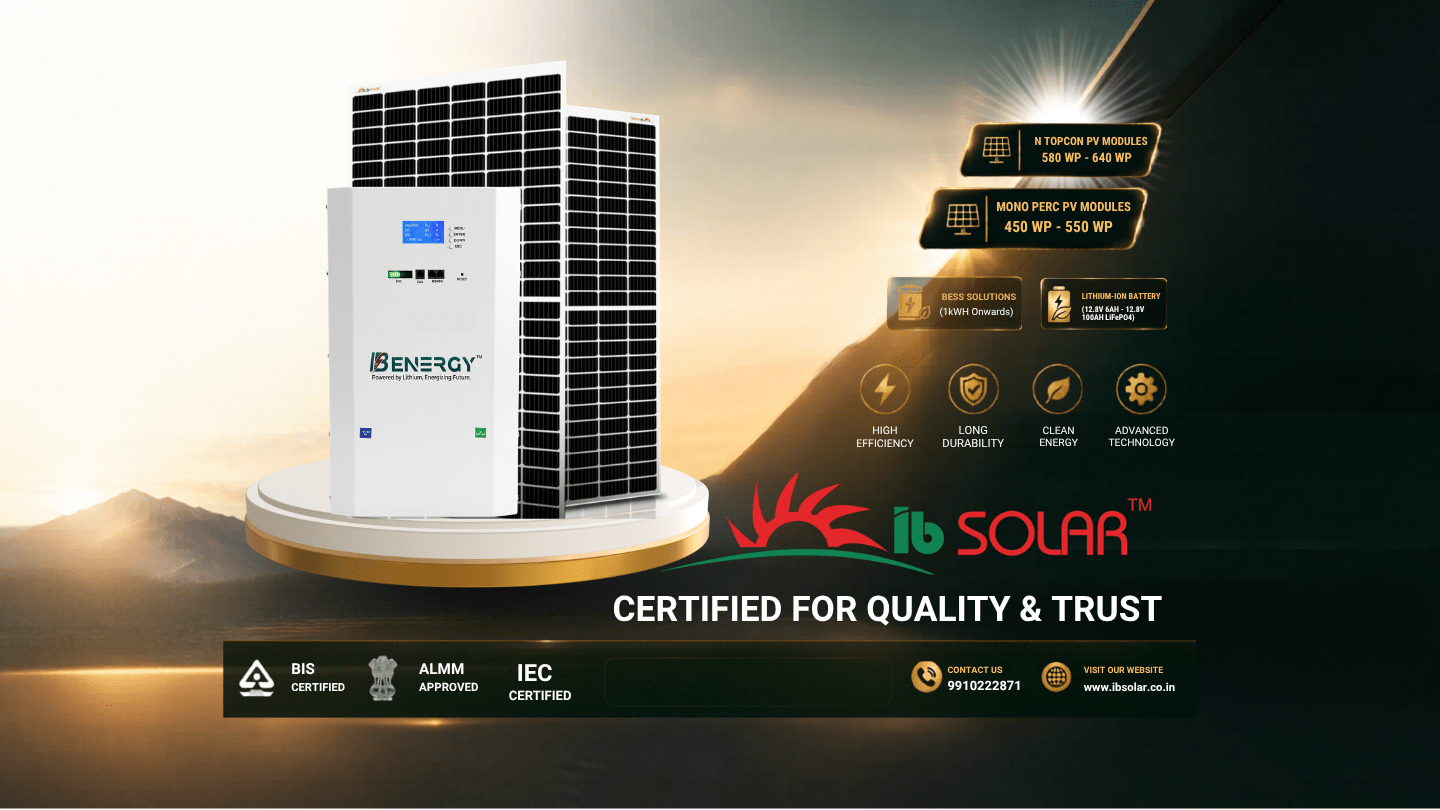
High-Efficiency Solar PV Modules
IB Solar focuses on advanced solar technologies, including:
- Mono PERC Solar Modules
- N-Type TOPCon Solar Panels
- Bifacial Solar Modules
- High-efficiency industrial PV systems
These technologies improve energy generation while optimising rooftop space utilisation.
Industrial EPC Expertise
Industrial rooftop projects involve complex execution requirements, including:
- Structural assessments
- Electrical integration
- Safety compliance
- High-capacity inverter systems
- Grid synchronisation
IB Solar provides complete EPC support from design and procurement to installation and maintenance.
Strong Presence in North India
With increasing industrial development across Delhi NCR, Uttar Pradesh, Haryana, Punjab, and Rajasthan, IB Solar is strategically positioned to support North India’s growing commercial solar demand.
Solar + BESS Integration
Modern industries increasingly require intelligent energy management systems. IB Solar supports integrated solar plus battery storage infrastructure to improve backup reliability and peak load management.
Types of Industrial Rooftop Solar Systems
Industrial rooftop solar systems can be customised based on energy consumption patterns and operational requirements.
On-Grid Solar Systems
These systems are connected directly to the electricity grid and help industries reduce power consumption from utilities.
Best suited for:
- Manufacturing units
- Warehouses
- Commercial buildings
- Industrial parks
Off-Grid Solar Systems
Off-grid systems operate independently using battery storage systems.
Best suited for:
- Remote industrial locations
- Areas with unreliable grid supply
- Critical operational facilities
Hybrid Solar Systems
Hybrid systems combine grid connectivity with battery storage for enhanced reliability and energy optimisation.
Best suited for:
- Data centres
- Hospitals
- High-load factories
- Continuous production facilities
Industrial Rooftop Solar vs Conventional Electricity
| Feature | Industrial Rooftop Solar | Conventional Grid Electricity |
|---|---|---|
| Electricity Cost | Lower long-term cost | Continuously increasing tariffs |
| Sustainability | Renewable and clean | Fossil fuel dependent |
| Energy Independence | High | Low |
| Operational Savings | Significant | Limited |
| Carbon Emissions | Minimal | High |
| ROI Potential | Strong | None |
| Long-Term Stability | Predictable | Volatile pricing |
Best Industries for Rooftop Solar Installation
Industrial rooftop solar systems are ideal for sectors with high daytime electricity consumption.
Manufacturing Plants
Factories can significantly reduce electricity costs through rooftop solar generation.
Warehouses and Logistics Parks
Large rooftop spaces make warehouses highly suitable for solar installations.
Textile Industries
Textile manufacturing facilities consume large amounts of energy and benefit greatly from solar integration.
Food Processing Units
Food industries require a stable energy supply for processing and refrigeration operations.
Automobile Manufacturing
Automotive industries increasingly adopt renewable energy to meet sustainability goals.
Data Centres
Data centres require uninterrupted power infrastructure and increasingly integrate solar with BESS systems.
Industrial Rooftop Solar Installation Process
A successful industrial solar project involves multiple technical and operational stages.
Site Assessment
Engineers evaluate:
- Roof structure
- Available area
- Load capacity
- Shading impact
- Energy consumption
System Design
Customised system architecture is created based on industrial requirements.
Procurement
High-efficiency solar modules, inverters, mounting structures, and electrical components are sourced.
Installation
Professional EPC teams execute the project with safety and compliance standards.
Grid Synchronisation
The solar system is connected with the electricity grid and monitoring systems.
Maintenance and Monitoring
Regular monitoring ensures optimal performance and long-term efficiency.
Future of Industrial Rooftop Solar in India
India’s industrial solar market is expected to witness exponential growth over the next decade.
Major growth drivers include:
- Rising industrial electricity demand
- Expansion of manufacturing infrastructure
- Government clean energy targets
- Falling solar technology costs
- Growth of energy storage systems
- Net-zero corporate commitments
Industrial rooftop solar is becoming a critical component of India’s energy transition strategy.
Frequently Asked Questions (FAQs)
What is an industrial rooftop solar installation?
Industrial rooftop solar installation refers to the deployment of solar photovoltaic systems on factory, warehouse, or industrial building rooftops to generate electricity for commercial operations.
How much does an industrial rooftop solar installation cost in India?
The cost depends on system capacity, solar technology, roof type, and energy requirements. Large industrial systems generally offer lower per-unit installation costs due to economies of scale.
How much electricity can rooftop solar generate for industries?
Industrial rooftop solar systems can generate substantial energy depending on rooftop size, solar irradiation, and module efficiency.
What is the ROI period for industrial solar systems?
Most industrial rooftop solar systems achieve ROI within 3 to 5 years while continuing to generate electricity for over 25 years.
Which solar technology is best for industrial projects?
High-efficiency technologies such as Mono PERC, N-Type TOPCon, and bifacial solar modules are increasingly preferred for industrial applications.
Why should industries choose IB Solar?
IB Solar offers customised industrial solar solutions, advanced PV module technologies, strong EPC expertise, scalable infrastructure, and dedicated support for commercial and industrial clients across North India.
Can rooftop solar work with battery storage systems?
Yes. Solar systems can be integrated with Battery Energy Storage Systems (BESS) for backup power, peak load management, and improved energy reliability.
Conclusion: Industrial Solar is Powering India’s Future
Industrial rooftop solar installation is rapidly transforming India’s commercial energy landscape. As electricity costs rise and sustainability becomes a business priority, industries are increasingly investing in solar infrastructure to improve operational efficiency and long-term profitability.
Companies like IB Solar are helping businesses transition toward cleaner, smarter, and more reliable energy ecosystems through advanced solar technologies, industrial EPC expertise, and scalable renewable energy solutions.
For factories, warehouses, manufacturing plants, and industrial facilities seeking energy independence and long-term savings, rooftop solar has become one of the most strategic investments of 2026.
Ready to reduce your industrial electricity costs?
Contact IB Solar today for a customised rooftop solar proposal and industrial energy consultation.