
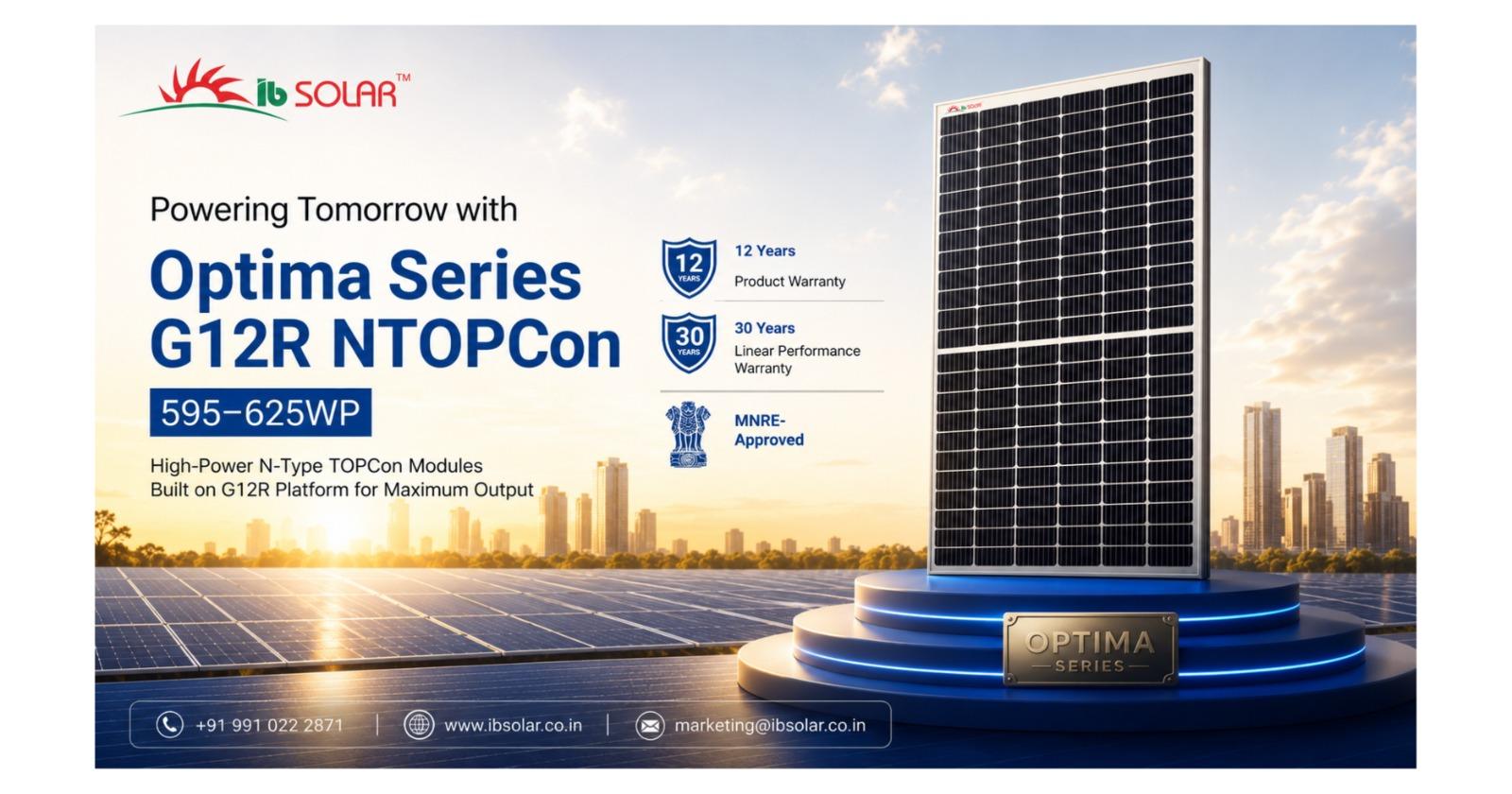
India’s solar energy landscape is undergoing a massive technology shift. As rooftops shrink and energy demands rise, older solar technology like Mono PERC is rapidly taking a back seat. Homeowners, commercial businesses, and utility developers are all chasing one critical metric: maximum energy generation from the minimum footprint.
Enter G12R N-Type TOPCon technology, the absolute gold standard in modern photovoltaic design.
If you are planning to invest in solar in 2026, understanding how this technology works will save you money, lower your Balance of System (BOS) costs, and dramatically increase your long-term return on investment (ROI). IB SOLAR’s flagship G12R N-Type TOPCon Glass-to-Glass Series is engineered specifically to lead this transition, pushing boundaries with up to 23.32% efficiency and massive power outputs of up to 630 Wp.
Decode the Tech: What Exactly is a G12R TOPCon Solar Panel?
A G12R TOPCon panel isn’t just a single upgrade; it is the perfect marriage of cell architecture and wafer shape innovations.
1. The G12R Advantage (The Shape)
For years, the solar industry relied on standard square silicon wafers (like the M10 or the massive G12 210mm square). The “R” in G12R stands for Rectangular.
By slicing the silicon wafer into an optimised rectangular format rather than a perfect square, IB SOLAR eliminates dead space on the panel surface. This revolutionary design allows us to pack significantly more active cell area into a highly practical, easy-to-handle module size. You get massive power density without an unwieldy, overly heavy panel.
2. The N-Type TOPCon Advantage (The Chemistry)
TOPCon stands for Tunnel Oxide Passivated Contact.
Conventional panels lose a lot of electricity internally because electrons recombine at the surface of the cell before they can be captured. TOPCon solves this by adding an ultra-thin tunnel oxide layer paired with a passivated contact architecture. This traps the electrons, forces them into the electrical current, and slashes internal losses to near zero.
Head-to-Head: G12R TOPCon vs. Traditional PERC Panels
To truly see why the market has shifted, look at how conventional Mono PERC stacks up against next-generation G12R TOPCon technology:
| Feature | Legacy Mono PERC Panels | IB SOLAR G12R TOPCon Panels |
| Peak Module Efficiency | Typically 20% – 21.5% | Up to 23.32% |
| Temperature Coefficient | Worse (Loses significant power in extreme summer heat) | Superior (Maintains stable power generation in peak summer) |
| Low-Light Performance | Standard | Excellent (Generates power earlier in the morning and during cloudy monsoon seasons) |
| First-Year Degradation | ~2.0% to 2.5% | Under 1.0% |
| Annual Degradation Rate | ~0.55% | Only 0.4% |
| Bifacial Power Gain | 70% Bifaciality Factor | Up to 85% Bifaciality Factor (+30% rear-side gain) |
Technical Specifications: IB SOLAR G12R Series
| Specification | Core Metric |
| Cell Technology | N-Type TOPCon (Highly resistant to LID/LeTID degradation) |
| Wafer Format | G12R Rectangular (Optimized aspect ratio) |
| Structural Design | Dual-Glass (Glass-to-Glass) Bifacial |
| Maximum Efficiency | Up to 23.32% |
| Power Output Range | Up to 630 Wp |
| Bifacial Rear-Side Gain | Up to 30% extra power yield |
| Positive Power Tolerance | 0 to +4.99 Wp |
| Mechanical Load Ratings | Front: 5400 Pa (Snow/Hail), Rear: 2400 Pa (Wind) |
The Core Benefits: Why IB SOLAR G12R TOPCon Outperforms the Rest
1. Unmatched Space Optimisation
Space is money, especially on residential and commercial roofs. Because the G12R wafer utilises every millimetre of the panel’s physical footprint, you require fewer panels to achieve your target system size. A 10kW system requires fewer modules, less mounting structure, and less wiring.
2. Up to 30% Bifacial Power Boost
By replacing the traditional plastic backsheet with heavy-duty transparent tempered glass, our Glass-to-Glass design allows the back of the panel to actively harvest reflected sunlight from the roof or ground.
Depending on your roof surface (especially white or light-colored surfaces), this bifacial gain can increase your total daily electricity generation by up to 30%.
3. Bulletproof Weather Durability & Lower Degradation
Traditional backsheets degrade, crack, and let in moisture over 25 years, leading to internal corrosion. IB SOLAR’s dual-glass design completely seals the solar cells from moisture, salt mist, and chemical pollutants. This is why our panels degrade at a tiny 0.4% per year, guaranteeing your system continues to produce massive amounts of power even in year 25 and beyond.
4. Beating the Indian Heat
Standard solar panels perform worse as they get hotter. However, our N-Type TOPCon cells feature an industry-leading low temperature coefficient. On blazing summer days when ambient temperatures cross 40°C, an IB SOLAR G12R panel will generate significantly more electricity than a traditional PERC panel.
Strategic Applications: Who is G12R Built For?
- Residential Homes: Ideal for modern homes with limited shadow-free roof space. Get maximum unit generation to completely offset high slab electricity bills.
- Commercial & Industrial (C&I): Perfect for factories, warehouses, and cold storage units looking to optimise their Levelized Cost of Energy (LCOE) and maximise corporate tax depreciation benefits.
- Utility & Agrivoltaics: Dramatically lowers Balance of System (BOS) costs, including racking, cabling, and installation labour, creating a much higher overall internal rate of return (IRR) for large developers.
Comprehensive Frequently Asked Questions (FAQs)
Technology & Architecture
1. What does the “R” stand for in G12R solar panels?
The “R” stands for Rectangular. Traditional G12 wafers are perfectly square ($210\text{ mm} \times 210\text{ mm}$). G12R technology alters this to a rectangular aspect ratio (typically $182\text{ mm} \times 210\text{ mm}$). This optimises cell spacing and eliminates unused internal dead space on the panel surface.
2. What is N-Type TOPCon technology, and how does it improve a panel?
N-type silicon is doped with phosphorus instead of boron, making it chemically immune to light-induced breakdown. TOPCon adds a molecularly thin tunnel-oxide passivation layer to the cell’s rear side. This allows electricity to pass through smoothly while reducing electron losses to near zero, unlocking record-high panel efficiency.
3. How does G12R differ from old M10 wafer technology?
M10 wafers ($182\text{ mm} \times 182\text{ mm}$) have a smaller surface area per cell. G12R expands one dimension to 210mm, combining the high-power performance of massive utility-scale cells with a highly balanced format optimised for compact commercial and residential roofs.
4. What is the efficiency rating of IB SOLAR’s G12R TOPCon modules?
IB SOLAR’s premium G12R N-Type TOPCon modules deliver a peak performance efficiency of up to 23.32%. This places it among the highest-performing mass-market solar modules available globally.
5. Why are N-Type panels considered superior to older P-Type panels?
P-type cells (used in traditional Mono PERC) use boron, which reacts with oxygen over time, causing permanent performance degradation. N-type cells use phosphorus, which does not suffer from this chemical defect, ensuring vastly more stable power generation for decades.
Real-World Performance & Output
6. How do IB SOLAR G12R TOPCon panels perform in extreme Indian summer heat?
Standard panels lose significant power when temperatures rise above 25°C. IB SOLAR’s G12R TOPCon cells feature an industry-leading temperature coefficient of just $-0.30\%/^{\circ}\text{C}$ (compared to $-0.35\%/^{\circ}\text{C}$ for PERC). This means that during scorching 45°C summer days, your panels will produce up to 2% more power hourly than legacy options.
7. Do these panels generate electricity on cloudy, rainy, or hazy days?
Yes. N-Type TOPCon technology excels in low-light and low-irradiance conditions. Because the cells absorb a wider spectral range of ambient light, they trigger power generation earlier in the morning, finish later in the evening, and maintain remarkably stable performance during overcast monsoons.
8. What is “Positive Power Tolerance” (0 to +4.99 Wp)?
Many cheap panels arrive under-performing their rated wattage. IB SOLAR guarantees a positive tolerance, meaning a 630W panel will exit the factory tested to deliver anywhere from 600W up to 604.99W. You never get less than what you paid for.
9. What is a “Bifaciality Factor,” and what is the maximum rear-side gain?
The bifaciality factor measures how efficient the back side of the panel is compared to the front. Our G12R modules boast a high bifaciality factor of up to 85%. Depending on the reflectivity of your roof or ground (e.g., white roofs or light sand), the rear side can generate up to an extra 30% of free electricity.
10. Does a glass-to-glass panel generate more power than a glass-backsheet panel?
Directly on the front side, the cell architecture dictates power. However, because a glass-to-glass panel completely swaps out the opaque plastic backsheet for a second layer of transparent tempered glass, it allows back-side light capture, creating a significantly higher cumulative energy yield over time.
Durability, Longevity & Lifecycle
11. What are the specific first-year and long-term degradation rates?
Traditional Mono PERC panels experience a sharp 2.5% performance drop in year one. In contrast, IB SOLAR’s G12R TOPCon panel limits first-year degradation to under 1%. From year two onward, the annual linear degradation drops to a tiny 0.4%, preserving your long-term energy yield.
12. What performance capacity is guaranteed after 25 and 30 years?
Due to ultra-low degradation rates, IB SOLAR G12R TOPCon panels are backed to retain roughly 87.4% of their original peak capacity at year 30. Standard Mono PERC panels usually drop to 80% or fail by year 25.
13. What are LID and LeTID, and are these panels immune to them?
LID (Light-Induced Degradation) occurs when fresh sunlight strikes a new panel, while LeTID (Light and elevated Temperature-Induced Degradation) occurs under intense heat. Because our N-Type phosphorus chemistry bypasses boron-oxygen defects entirely, the G12R module is virtually immune to both issues.
14. What are the mechanical load capacities of IB SOLAR G12R panels?
Our dual-glass framework is built to handle heavy weather. It is strictly certified to withstand up to 5400 Pa of mechanical snow or hail pressure on the front face and up to 2400 Pa of high-velocity wind pressure on the rear face.
15. How does the glass-to-glass construction prevent internal microcracks?
Solar cells are brittle and thin. Traditional single-glass panels bend and flex under wind, causing microscopic fractures in the silicon over time. Double-glass construction acts like a rigid sandwich, placing the active cells dead-centre on a stable neutral axis where bending stresses drop to near zero, completely preventing microcracks.
ROI, Installation & Logistics
16. How do G12R panels lower Balance of System (BOS) costs?
Because G12R rectangular wafers optimise power density, each panel outputs much higher wattage (up to 630 Wp). To build a 100kW plant, you require significantly fewer individual panels. This directly cuts down on your spending for aluminium mounting structures, DC wiring, civil works, and manual on-site labor.
17. How does the shape of the G12R panel optimise shipping and logistics costs?
G12R rectangular dimensions are explicitly designed to align with international shipping container space. By eliminating awkward sizing gaps inside transit crates, container space utilisation jumps to an incredible 98.5%. This lowers per-watt shipping costs and passes the savings directly to you.
18. Why should I pay a premium for TOPCon over cheaper Mono PERC panels?
While traditional PERC panels have a marginally lower upfront sticker price, they degrade faster and drop in efficiency during hot days. A premium G12R TOPCon system generates up to 5–8% more cumulative lifetime energy. The tiny initial premium is typically fully recovered in under 12 to 18 months through increased energy savings.
19. Are IB SOLAR G12R TOPCon modules ALMM listed and BIS certified?
Yes. All IB SOLAR production lines are fully Bureau of Indian Standards (BIS) compliant and undergo stringent quality benchmarks. Our modules meet all institutional guidelines for grid-interactive solar projects, making them perfect for private installations and government subsidy schemes.
20. What are the best applications for G12R Glass-to-Glass panels?
The high power density and ruggedised build make the G12R series exceptionally versatile. It is ideal for residential rooftops with limited spacing, commercial and industrial (C&I) facilities aiming to slash high operational costs, and utility solar farms aiming for the lowest possible Levelized Cost of Energy (LCOE).
Ready to power your business with next-generation solar technology?
Contact IB Solar today for customised TOPCon solar solutions and renewable energy infrastructure.