
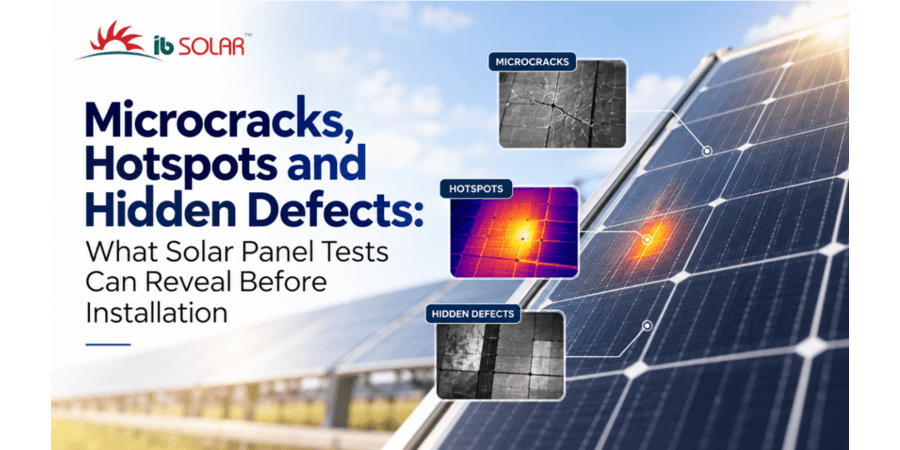
Solar panels are designed to generate clean electricity for decades, but their long-term performance depends on more than efficiency ratings and appearance. Some defects remain invisible to the naked eye yet can affect power output, reliability and safety over time. Microcracks, hotspots and manufacturing inconsistencies are among the issues that quality testing can help identify before panels reach an installation site.
For homeowners, businesses and solar project developers, understanding these tests is an important step towards making informed solar investments.
Why Solar Panel Testing Matters
A solar module may look flawless and still contain defects within its photovoltaic cells. These issues can arise during manufacturing, handling, transportation or storage. If they go undetected, certain defects may contribute to reduced energy generation, localised heating or premature module degradation.
Testing helps manufacturers and quality teams assess whether a module meets specified performance and safety requirements. It also provides valuable information about defects that visual inspection alone may miss.
Here are three critical issues that solar panel testing can reveal.
1. Microcracks: Small Fractures, Long-Term Consequences
Microcracks are tiny fractures in the silicon cells that convert sunlight into electricity. They may develop due to mechanical stress during manufacturing, transportation, installation or exposure to environmental loads.
Not every microcrack immediately affects a panel’s output. However, depending on its location and severity, a crack can interrupt electrical pathways within a cell. Over time, changes in operating conditions or further mechanical stress may cause the affected area to become electrically isolated, reducing the cell’s contribution to power generation.
How are microcracks detected?
Electroluminescence (EL) testing is one of the most effective methods for identifying cell cracks that are difficult to see under normal lighting. During this test, a current is passed through the module, causing the cells to emit infrared light. A specialised camera captures the emission pattern, revealing irregularities that may indicate cracks, inactive regions or other cell defects.
For quality assurance, EL images can provide a useful record of a module’s condition before installation.
2. Hotspots: When Localised Heating Becomes a Risk
Hotspots occur when a particular area of a solar module heats up significantly more than surrounding areas. They can develop when cells or sections of cells are shaded, damaged or electrically mismatched, causing them to dissipate energy instead of contributing normally to power generation.
Persistent hotspots can accelerate material degradation and, in severe cases, damage encapsulants, backsheets or other module components. Their impact depends on factors such as operating conditions, module design and the nature of the underlying fault.
How are hotspots detected?
Infrared thermography uses thermal imaging cameras to identify unusual temperature patterns across a module. During appropriate testing, abnormal heating may indicate cell mismatch, electrical defects or other performance issues.
Thermal imaging is particularly useful when interpreted alongside electrical measurements and other diagnostic tests. It helps identify areas requiring further investigation rather than treating every temperature variation as proof of a defect.
3. Hidden Defects: Beyond What the Eye Can See
Microcracks and hotspots are only part of the picture. Other issues may include soldering defects, cell interconnection problems, delamination, moisture-related damage and inconsistencies in electrical performance.
Different tests reveal different aspects of module quality:
- Visual inspection: Identifies visible damage, broken glass, discolouration and manufacturing irregularities.
- Flash testing (I-V curve measurement): Measures electrical output under controlled conditions to assess parameters such as power, current and voltage.
- Electroluminescence testing: Reveals cell-level defects, including many cracks and inactive regions.
- Infrared thermography: Identifies abnormal temperature patterns associated with potential electrical or thermal issues.
- Insulation and safety testing: Evaluates relevant electrical safety characteristics in accordance with applicable standards.
No single test can detect every defect. A comprehensive quality assurance programme combines appropriate methods to build a more reliable picture of module condition.
What Should Buyers Look for Before Installation?
When evaluating solar modules, buyers and project developers should consider more than the advertised wattage. Look for traceable product documentation, applicable certification, manufacturer quality controls and reliable electrical performance data.
For large projects, additional inspection or testing may be appropriate depending on procurement requirements, project risks and applicable standards. Any suspected defects should be assessed by qualified personnel before installation or commissioning.
It is also important to distinguish between factory quality assurance and independent inspection: the scope and reliability of testing depend on the procedures followed, equipment used and competence of the testing personnel.
Solar panels are a long-term investment, and their performance depends on the quality of the modules selected as well as correct system design and installation. Detecting defects before installation can help reduce avoidable rework, improve quality control and support more dependable solar energy generation.
At IB Solar, quality-conscious solar procurement begins with understanding what lies beyond a panel’s surface. By recognising the role of inspection, electrical testing and advanced diagnostic techniques, buyers can make better-informed decisions and build greater confidence in their solar projects.
Choose solar with quality in mind. Because dependable performance begins long before the first unit of electricity is generated.