
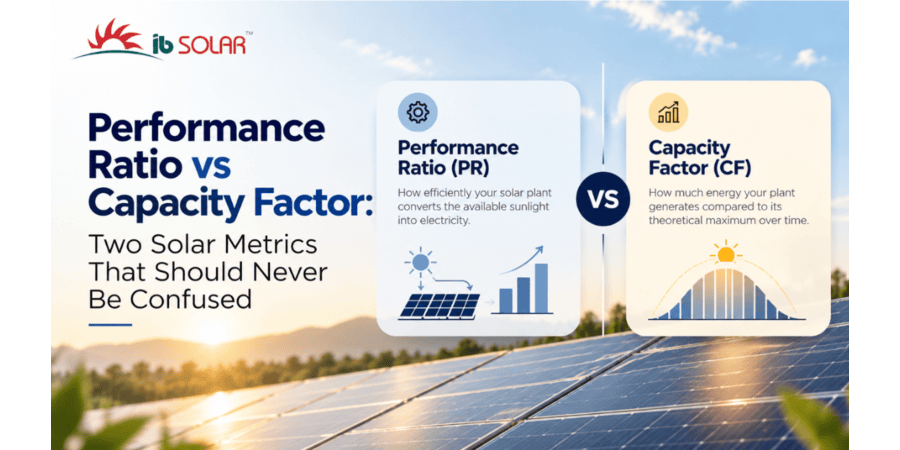
In solar power, generating more electricity is not always proof of better system performance, and a high performance score does not automatically translate into higher annual generation.
Two metrics frequently used to evaluate photovoltaic (PV) plants are Performance Ratio (PR) and Capacity Factor (CF). Although both help assess solar plant performance, they answer fundamentally different questions. Confusing them can lead to misleading comparisons, flawed project evaluations and incorrect conclusions about plant efficiency.
For solar developers, EPC contractors, asset owners and investors, understanding the distinction is essential to evaluating a project’s technical performance and commercial potential.
What Is Performance Ratio in Solar Power?
Performance Ratio measures how effectively a solar PV system converts the available solar irradiation into usable electrical energy, relative to its rated capacity.
In simple terms, it helps answer this question: How well is my solar plant performing against the energy it could be expected to produce from the sunlight it receives?
A commonly used formulation for AC-side performance ratio is:
PR (%) = (Actual AC energy generated ÷ Expected energy based on irradiation and rated DC capacity) × 100
The expected energy is calculated using the solar irradiation received on the module plane and the installed DC capacity, with the appropriate reference irradiance.
PR reflects the combined effects of system losses, including module temperature, soiling, shading, inverter conversion, wiring losses and equipment performance. Its precise interpretation depends on the measurement boundary and methodology used.
A lower-than-expected PR may indicate that the system is losing more energy than anticipated. However, PR must be interpreted in context: temperature, seasonality, measurement quality and the chosen calculation method can all influence the result.
For example, a plant may generate less electricity during a cloudy month simply because less sunlight is available. If the plant converts that available irradiation into electricity efficiently, its PR may still remain relatively healthy.
What Is Capacity Factor in Solar Power?
Capacity Factor measures the actual energy generated over a specified period against the maximum energy the plant could have generated if it had continuously operated at its rated power throughout that period.
It answers a different question: How much energy did the plant generate compared with its theoretical maximum output over time?
The formula is:
CF (%) = (Actual energy generated ÷ (Rated capacity × Total hours in the period)) × 100
For annual calculations, the denominator uses 8,760 hours in a standard 365-day year.
Capacity Factor is influenced by the solar resource available at the location, seasonal weather, plant design, equipment availability, grid outages, curtailment and other operating constraints. The capacity basis used in the calculation—MWp DC or MW AC—must also be stated clearly.
Because sunlight is not available at full intensity throughout the day, solar PV plants do not normally operate at their rated output around the clock. Consequently, a relatively modest annual Capacity Factor does not, by itself, indicate poor plant quality.
Performance Ratio vs Capacity Factor: The Critical Difference
| Parameter | Performance Ratio (PR) | Capacity Factor (CF) |
| What it measures | Performance relative to the available solar resource | Energy generated relative to theoretical maximum output over time |
| Primary reference | Solar irradiation and installed DC capacity | Rated capacity and hours in the period |
| Key influences | System losses, temperature and equipment performance | Solar resource, design, downtime and operating constraints |
| Typical use | Technical performance monitoring and loss analysis | Energy production assessment and project evaluation |
| Main question | How effectively is the system using the sunlight it receives? | How much energy is the plant generating relative to its rated capacity? |
The two metrics are complementary, not interchangeable. A plant with a higher PR can still have a lower CF than another plant if it receives less irradiation or operates under different constraints.
An Example: Why the Numbers Tell Different Stories
Consider a hypothetical solar plant with a DC capacity of 1 MWp, an annual plane-of-array irradiation of 1,800 kWh/m² and annual AC generation of 1,350 MWh.
Assuming the standard reference irradiance of 1 kW/m², its reference yield is 1,800 equivalent hours, while its actual final yield is 1,350 kWh per kWp.
Its Performance Ratio is therefore:
PR = (1,350 ÷ 1,800) × 100 = 75%
Now, if the same plant has an AC rated capacity of 1 MW, its annual Capacity Factor is:
CF = (1,350 MWh ÷ (1 MW × 8,760 hours)) × 100 ≈ 15.4%
These figures are not contradictory. The 75% PR describes performance relative to the irradiation received, while the 15.4% CF describes annual generation relative to the plant’s rated AC capacity operating continuously.
The example also illustrates why the DC/AC capacity basis must be documented when comparing projects.
Why Both Metrics Matter for Solar Project Owners
For developers and EPCs, PR can help identify excessive losses, investigate underperformance and validate operational improvements. CF helps assess actual energy production over time and supports energy-yield planning and commercial evaluations.
For investors and asset owners, neither metric should be viewed in isolation. A meaningful assessment should also consider specific yield (kWh/kWp), plant availability, irradiation data, degradation, curtailment, contractual guarantees and the actual energy delivered at the relevant measurement point.
Comparisons are most useful when projects use consistent reporting periods, capacity definitions, measurement boundaries and calculation methodologies. Without this consistency, even apparently precise percentages can create misleading conclusions.
Conclusion: Measure What Matters
Performance Ratio and Capacity Factor reveal different dimensions of solar plant performance. PR helps assess how effectively a PV system converts the available solar resource into electricity, while CF measures how much energy it produces relative to its rated capacity over time.
For a more complete picture, solar professionals should evaluate both metrics alongside energy yield, availability and operational data.
At IB Solar, understanding solar performance goes beyond installed capacity or headline efficiency figures. Reliable project evaluation requires a clear understanding of how technology, system design, environmental conditions and operating practices influence actual energy generation.
Because in solar, measuring performance accurately is the first step towards improving it.