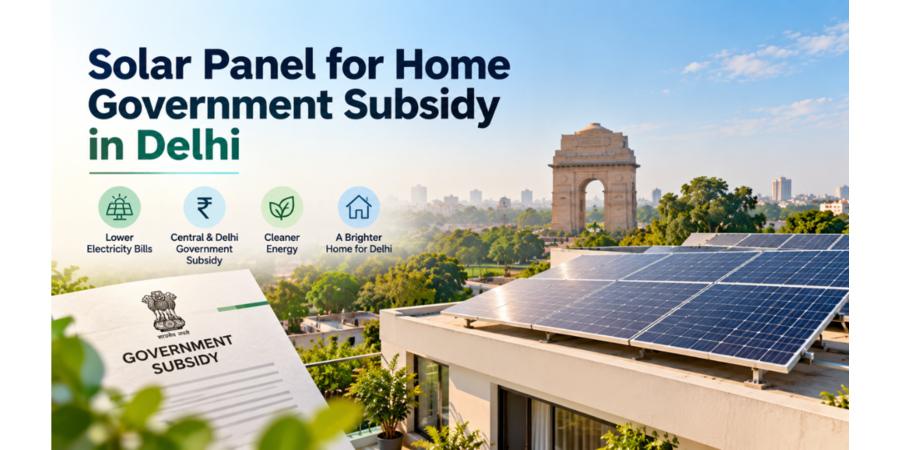
Installing solar panels at home in Delhi can help reduce electricity bills while making your household more energy-efficient. With the Central Government’s PM Surya Ghar: Muft Bijli Yojana and Delhi’s state-level solar incentives, eligible homeowners may receive financial assistance towards rooftop solar installation.
If you are searching for solar panel for home government subsidy in Delhi, this guide explains the available subsidies, eligibility criteria, application process, installation costs, and how to choose the right rooftop solar solution.
At IB Solar, we believe that understanding government incentives is an important first step towards adopting solar energy. Here’s what Delhi homeowners should know before investing in a rooftop solar system.
Is There a Government Subsidy for Solar Panels at Home in Delhi?
Yes. Eligible residential consumers in Delhi can explore two forms of support:
- Central Government subsidy: Available under PM Surya Ghar: Muft Bijli Yojana for eligible residential rooftop solar installations.
- Delhi Government subsidy: Additional capital subsidy under the Delhi Solar Energy Policy, subject to the current scheme conditions.
The amount you receive depends on the installed capacity, eligible project cost, applicable scheme rules, and the verification process. The Delhi Solar Portal provides the current subsidy structure and an online calculator to estimate applicable benefits.
1. Central Government Solar Panel Subsidy in Delhi
The PM Surya Ghar: Muft Bijli Yojana is a national scheme designed to encourage residential rooftop solar adoption.
For eligible residential households, the current central subsidy structure is:
| Rooftop solar capacity | Central subsidy |
| 1 kW | ₹30,000 |
| 2 kW | ₹60,000 |
| 3 kW | ₹78,000 |
| Above 3 kW | Maximum ₹78,000 |
The central subsidy provides ₹30,000 per kW for the first 2 kW and ₹18,000 for the additional capacity up to 3 kW. There is no additional central subsidy for capacity above 3 kW under this structure.
For example, a household installing a 4 kW rooftop solar system may still receive a maximum central subsidy of ₹78,000, subject to eligibility and scheme approval.
Important: The subsidy is not an automatic discount offered by every solar installer. Applicants must follow the prescribed application and installation process through the official scheme.
2. Delhi Government Solar Panel Subsidy
In addition to central assistance, Delhi has a state-level capital subsidy under its Solar Energy Policy.
According to the Delhi Solar Portal’s updated subsidy information, the state subsidy structure for residential consumers is linked to the installed capacity and the applicable cost determined under the scheme’s implementation model. The portal specifies a potential state capital subsidy of up to ₹26,000 per kW, subject to the prescribed calculation and a maximum cap of ₹78,000.
The actual amount may be lower depending on the cost determined through the applicable bidding process and the central subsidy. Do not assume that every household will automatically receive the maximum amount.
Delhi’s official portal also provides a calculator to estimate the central subsidy, state subsidy, effective installation cost, electricity bill savings, and generation-based incentives.
Check the current details at the Delhi Solar Portal.
- How Much Total Solar Subsidy Can You Get in Delhi?
Eligible households may qualify for both central and state capital assistance. However, the final amount depends on the current scheme rules, eligible system cost, and applicable limits.
The following table illustrates the central subsidy alongside the potential state subsidy ceiling. These figures are indicative, not a guarantee of the amount payable to an individual household.
| Solar capacity | Central subsidy | Potential Delhi state subsidy ceiling* |
| 1 kW | ₹30,000 | Up to ₹26,000 |
| 2 kW | ₹60,000 | Up to ₹52,000 |
| 3 kW | ₹78,000 | Up to ₹78,000 |
| 4 kW | ₹78,000 | Up to ₹78,000 |
*The state subsidy is subject to the prescribed cost-based calculation and maximum limits. The applicable amount may be lower. Confirm the estimate using the official Delhi Solar Portal calculator before making a purchase.
The key takeaway is that Delhi homeowners should check both central and state benefits instead of calculating their solar investment using the central subsidy alone.
4. Who Is Eligible for Solar Panel Subsidy in Delhi?
Eligibility depends on the scheme and the installation model. For the central PM Surya Ghar subsidy, the general requirements include:
- The applicant should be an eligible residential electricity consumer.
- The household should have a grid-connected electricity connection with the relevant Delhi DISCOM.
- The rooftop solar installation must follow the scheme’s technical and procedural requirements.
- The application must be registered through the official national portal.
- The installation must use a vendor empanelled under the PM Surya Ghar scheme for the applicable DISCOM.
- Required inspections, commissioning formalities, and other scheme conditions must be completed.
Commercial and industrial electricity consumers are not eligible for the central residential subsidy under PM Surya Ghar. They should check the applicable Delhi Solar Policy provisions and DISCOM procedures instead.
- How to Apply for Solar Panel Subsidy in Delhi
The process generally follows these steps.
Step 1: Register on the National Portal
Visit the official PM Surya Ghar portal and register using your electricity consumer details and other requested information.
Step 2: Submit Your Rooftop Solar Application
Select the appropriate DISCOM and submit the rooftop solar application through the portal.
Step 3: Obtain Technical Feasibility Approval
Your electricity distribution company reviews the application and issues technical feasibility approval if the requirements are met.
Step 4: Choose an Eligible Vendor
Select a vendor empanelled for the PM Surya Ghar scheme under your DISCOM. Confirm the equipment specifications, installation scope, warranty terms, and total cost before signing the agreement.
Step 5: Install the Rooftop Solar System
The selected vendor installs the system in accordance with the applicable technical requirements.
Step 6: Complete Inspection and Commissioning
Follow the portal’s instructions for installation verification, commissioning, and the required meter-related formalities.
Step 7: Submit Bank Details and Claim the Subsidy
Submit the required bank details and documents through the prescribed portal process. The subsidy is released after the relevant conditions and verification requirements are fulfilled.
For Delhi’s additional state subsidy, check the separate requirements on the Delhi Solar Portal, including the capital subsidy application and status facilities.
- Which Solar Panel Capacity Is Suitable for Your Home?
The right solar system size depends on your monthly electricity consumption, available shadow-free rooftop area, roof structure, and daytime energy use.
The Delhi Solar Portal provides the following general guidance:
| Average monthly consumption | Indicative rooftop solar capacity |
| 0–150 units | 1–2 kW |
| 150–300 units | 2–3 kW |
| Above 300 units | Above 3 kW |
These are indicative ranges, not fixed recommendations. A site assessment and review of your electricity bills can help determine the appropriate capacity.
1 kW Solar System
A 1 kW rooftop solar system may suit a household with relatively low electricity consumption and adequate roof space.
2 kW Solar System
A 2 kW system may suit a small household with moderate electricity usage, depending on its appliances and consumption pattern.
3 kW Solar System
A 3 kW system may suit a household with higher electricity consumption. Under the current central subsidy structure, this capacity reaches the maximum central subsidy of ₹78,000.
4 kW and Larger Solar Systems
Larger systems may be appropriate for homes with higher electricity demand, air conditioners, electric appliances, or future electric vehicle charging needs. Remember that central subsidy does not increase beyond the prescribed ₹78,000 cap under the current structure.
7. How Much Does a Solar Panel System for Home Cost in Delhi?
The cost of rooftop solar installation varies according to system capacity, module technology, inverter selection, mounting structures, roof conditions, wiring, safety equipment, and installation requirements.
Your effective cost is calculated after accounting for the eligible subsidy and any applicable scheme benefits. For an accurate estimate, request a detailed quotation that clearly separates equipment, installation, electrical work, meter-related charges, and other costs.
Before comparing quotes, check:
- Solar module make, model, and rated capacity
- Inverter specifications and warranty
- Mounting structure and corrosion protection
- Installation and electrical safety provisions
- Monitoring and after-sales service
- Subsidy eligibility and exclusions
- Net-metering and commissioning responsibilities
Do not choose a system based only on the lowest upfront price. Equipment quality, installation workmanship, and service support also influence long-term performance.
8. Benefits of Installing Solar Panels at Home in Delhi
Lower Electricity Bills
A properly sized rooftop solar system can reduce the amount of electricity you need to purchase from the grid. Your savings depend on actual generation, household consumption, tariffs, and the applicable metering arrangement.
Government Financial Assistance
Eligible households can reduce the initial investment through central and applicable Delhi state incentives.
Greater Energy Independence
Generating electricity at home can reduce dependence on grid electricity during daylight hours. A standard grid-connected system generally shuts down during a grid outage unless it includes suitable backup equipment.
Long-Term Energy Planning
Solar panels can help households manage a portion of their future electricity expenditure. Actual returns depend on installation costs, system performance, maintenance, and electricity tariffs.
Environmental Benefits
Solar energy generates electricity without direct fuel combustion during operation, helping reduce reliance on conventional grid electricity.
9. What Should You Look for in a Solar Panel Brand?
Selecting the right solar equipment is as important as understanding the subsidy.
When evaluating solar panels for your home, consider the following factors:
- Module efficiency: Compare rated output and efficiency for the available roof area.
- Technology: N-Type TOPCon and other module technologies should be assessed against the project’s performance and cost requirements.
- Certifications and eligibility: Confirm compliance with applicable standards and scheme requirements.
- Product and performance warranties: Review the written warranty terms and exclusions.
- Installer expertise: Ensure the installation team follows appropriate electrical and structural safety practices.
- Service support: Check who will handle maintenance, monitoring, and warranty claims.
IB Solar offers solar modules and solar energy solutions for different applications. Homeowners can explore the available products and discuss their project requirements before making a decision.
10. Why Consider IB Solar for Your Solar Requirements?
IB Solar is part of India’s solar energy ecosystem, offering solar modules and solutions for rooftop and other solar applications.
When planning a residential rooftop project, homeowners should evaluate the proposed module specifications, system design, inverter compatibility, installation quality, and after-sales support.
IB Solar can help you explore suitable solar product options and understand the technical considerations involved in a rooftop installation. If you intend to claim the PM Surya Ghar subsidy, verify that the installer you select is currently empanelled for your DISCOM and the applicable scheme.
Explore IB Solar’s website to learn more about its solar products and solutions.
11. Important Deadline for Delhi Homeowners
The Delhi Solar Portal currently displays 28 February 2027 as the scheme closing date for PM Surya Ghar benefits in Delhi, and states that the scheme is available on a first-come, first-served basis to the first 2,20,000 eligible consumers.
Scheme timelines and availability may change. Check the official Delhi Solar Portal and the PM Surya Ghar portal for the latest status before planning your installation.
Frequently Asked Questions
1. How much subsidy is available for solar panels at home in Delhi?
The central subsidy is ₹30,000 per kW for the first 2 kW and ₹18,000 for the additional capacity up to 3 kW, capped at ₹78,000. Eligible households may also qualify for Delhi’s state capital subsidy, subject to the current rules and cost-based calculation.
2. Can I get both central and Delhi Government solar subsidies?
Eligible residential consumers may qualify for central and state assistance. The final amount depends on the current scheme provisions, eligible installation cost, and prescribed limits. Use the official Delhi Solar Portal calculator to estimate your benefits.
3. Can tenants apply for rooftop solar subsidy?
Eligibility depends on the electricity connection, property permissions, installation arrangement, and applicable scheme rules. Tenants without suitable roof access can explore alternative models, such as community solar, where available under Delhi’s solar framework.
4. Is the PM Surya Ghar subsidy available for commercial buildings?
The central PM Surya Ghar subsidy discussed in this article is for eligible residential consumers, not commercial and industrial electricity consumers. Businesses should check the applicable Delhi Solar Policy provisions.
5. Do I need to choose a government-approved vendor?
To claim the central PM Surya Ghar subsidy, consumers must select a vendor empanelled under the scheme for their DISCOM. Always verify the current empanelment status before signing a contract.
6. How long does it take to receive the subsidy?
The timeline depends on application completeness, installation, inspection, commissioning, and the processing of the subsidy claim. Follow the official portal for status updates and respond promptly to requests for additional information.
7. Will solar panels eliminate my electricity bill?
Not necessarily. Bill savings depend on your consumption, solar generation, system size, metering arrangement, and applicable electricity charges. A grid-connected system may still have fixed charges or other bill components.
8. Where can I calculate my solar subsidy in Delhi?
Use the Delhi Solar Portal’s rooftop solar calculator. It provides estimates for feasible system capacity, installation cost, applicable subsidies, monthly generation-based incentives, bill savings, and payback period.
Make the Most of Solar Panel Subsidy in Delhi
For homeowners searching for solar panel for home government subsidy in Delhi, the first step is to understand the central PM Surya Ghar scheme and the additional benefits available under Delhi’s Solar Energy Policy.
Choose a system based on your electricity consumption and roof conditions, compare detailed quotations, verify your installer’s eligibility, and complete the prescribed application and commissioning process.
With the right planning, rooftop solar can help reduce electricity bills and support a more sustainable household energy strategy.
Planning to install solar panels at home? Explore IB Solar to learn more about solar products and discuss your rooftop solar requirements.

