“This scheme is a part of our efforts to build an energy-secure, green and future-ready India.”
— Prime Minister Narendra Modi
India’s solar journey has been nothing short of remarkable. Over the past decade, the country has emerged as one of the world’s fastest-growing solar markets, transforming barren lands, industrial rooftops and residential buildings into sources of clean electricity. Today, solar energy forms the backbone of India’s ambition to achieve 500 GW of non-fossil fuel capacity by 2030, while reducing dependence on imported fossil fuels and lowering carbon emissions.
Yet, success has brought with it a new challenge.
Large-scale solar parks require enormous parcels of land. Acquiring these sites is often expensive, time-consuming and socially sensitive, particularly in a country where agricultural land, forests and urban infrastructure are all competing for space. As electricity demand continues to rise, India’s clean energy transition cannot rely on land alone.
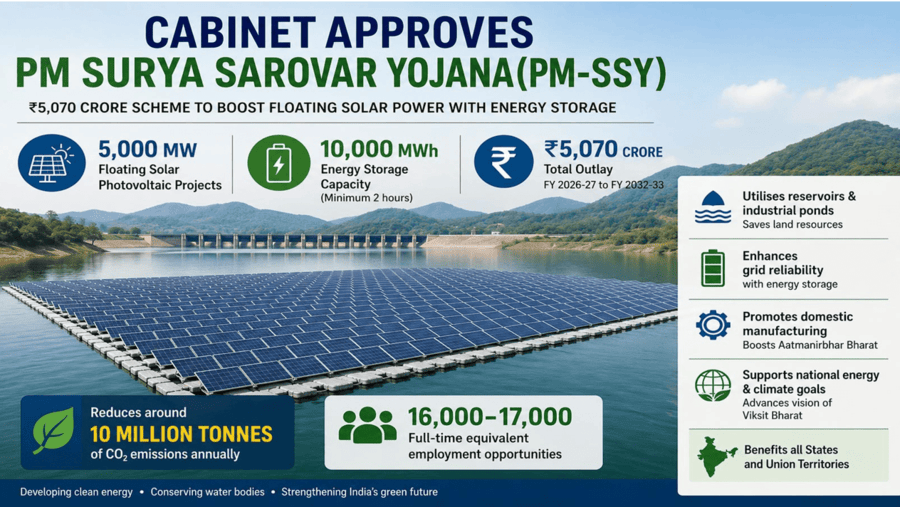
Recognising this challenge, the Union Cabinet has approved the Pradhan Mantri Surya Sarovar Yojana (PM-SSY)—a landmark initiative that could redefine the future of solar power in the country. With a financial outlay of ₹5,070 crore, the scheme aims to develop 5 GW of Floating Solar Photovoltaic (FSPV) projects integrated with Energy Storage Systems (ESS) between FY 2026-27 and FY 2030-31. It also provides financial assistance for project feasibility studies and technical assessments, helping developers reduce project risks before construction begins.
So, What Exactly is Floating Solar?
Imagine a solar power plant—not on a barren field, but floating peacefully on the surface of a reservoir.
Floating solar systems use specially engineered buoyant platforms that support photovoltaic modules on lakes, dams, reservoirs, quarry pits and industrial ponds. The electricity generated is transmitted to the grid just like any conventional solar plant, but without occupying valuable land.
For a country where land availability is increasingly becoming a developmental bottleneck, this is a significant shift in thinking.
The National Institute of Solar Energy estimates that India possesses nearly 102 GW of floating solar potential across its inland water bodies. In comparison, India’s current installed floating solar capacity is only around 700 MW, highlighting how much untapped opportunity still exists.
Why Floating Solar Matters More Than Ever
The biggest advantage of floating solar is obvious—it saves land.
Instead of converting agricultural fields or clearing new sites, existing reservoirs and industrial water bodies can become productive clean energy assets. This reduces land acquisition challenges while enabling states with limited land availability to expand renewable energy generation.
There are technical advantages as well.
Solar panels tend to perform better at lower temperatures. Since floating systems are naturally cooled by the surrounding water, they often operate more efficiently than comparable ground-mounted installations, particularly during hot summer months. While performance improvements vary by project and climate, this passive cooling effect can contribute to better energy generation over time.
Floating solar also offers an unexpected environmental benefit. By partially covering reservoirs, these systems reduce direct sunlight falling on the water surface, slowing evaporation. In a country increasingly grappling with water stress, preserving stored water while simultaneously generating electricity represents a powerful example of resource optimisation.
The Missing Piece: Why Energy Storage Changes Everything
Perhaps the most significant feature of the PM-SSY scheme is not floating solar itself—but its integration with Energy Storage Systems (ESS).
One of the most common criticisms of solar energy is that electricity generation stops when the sun goes down. Batteries solve this challenge by storing excess electricity generated during daylight hours and supplying it later when demand remains high.
Think of it like charging your phone during the day so you can continue using it at night.
By mandating co-located storage with a minimum two-hour capacity, the scheme aims to improve grid stability, reduce fluctuations in renewable power supply and make clean energy more dependable for consumers and industries alike.
Learning from the World
India is not the first country to explore floating solar.
China has developed some of the world’s largest floating solar farms, including projects built over former coal mining areas that have since filled with water—transforming old industrial landscapes into renewable energy hubs.
Singapore, constrained by limited land availability, has successfully deployed floating solar installations on reservoirs to diversify its energy mix without sacrificing valuable urban space.
In Europe, countries such as the Netherlands have demonstrated how floating solar can complement existing renewable infrastructure, integrating seamlessly with water management systems.
India now has the opportunity to adapt these global learnings at an even larger scale, supported by one of the world’s fastest-growing renewable energy ecosystems.
More Than Clean Energy: Building an Industry
The impact of PM-SSY extends far beyond electricity generation.
According to the Cabinet announcement, the scheme is expected to reduce nearly 10 million tonnes of CO₂ emissions every year while creating approximately 16,000–17,000 full-time equivalent jobs across manufacturing, engineering, installation, operations and maintenance. It also aims to strengthen domestic manufacturing of floating platforms, PV modules, battery systems and associated technologies, reinforcing India’s vision of Aatmanirbhar Bharat.
For businesses across the renewable energy value chain, this opens new opportunities in project development, engineering services, energy storage integration and advanced solar technologies.
A Defining Moment for India’s Energy Transition
Every major phase of India’s renewable energy journey has been driven by innovation—from utility-scale solar parks to rooftop installations and now integrated solar-plus-storage systems.
Floating solar represents the next logical evolution.
It demonstrates that the future of renewable energy is not simply about installing more panels. It is about using existing resources more intelligently, reducing pressure on land, strengthening grid resilience and ensuring that sustainability goes hand in hand with economic growth.
The PM Surya Sarovar Yojana is therefore much more than a government scheme. It is a blueprint for how India can rethink infrastructure, unlock underutilised assets and accelerate its transition towards a cleaner, more resilient energy future.
As the nation moves beyond rooftops, its reservoirs may well become the next engines of India’s renewable energy revolution.