India’s solar transition is entering a more complicated phase.
For more than a decade, the central question was how quickly India could add solar capacity. Today, the question is increasingly how efficiently the country can build, move, finance, integrate and consume that solar power.
That distinction matters.
A solar project is no longer simply a module installed on a piece of land. Behind every megawatt is a complex chain spanning polysilicon, wafers, cells, modules, glass, inverters, cables, logistics, financing, land, transmission, storage and eventually the end user.
India is therefore not merely expanding solar generation. It is attempting to rebuild the supply chain that supports solar generation.
The supply chain is becoming the real battleground
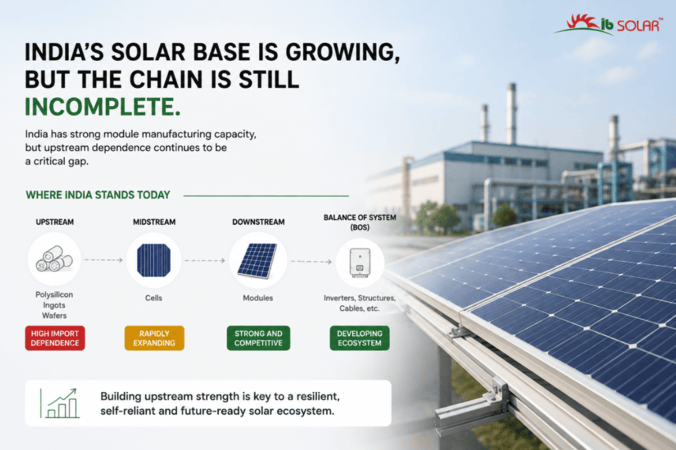
India’s manufacturing base has expanded rapidly, particularly at the module level. But the supply chain remains uneven.
The country has developed substantial module assembly capacity, while upstream segments such as polysilicon, ingots and wafers remain comparatively underdeveloped. Industry assessments continue to identify imported wafers and upstream materials as major vulnerabilities. CEEW’s 2026 analysis also notes that Indian cell and module manufacturing costs remain higher than those in China, while wafer dependence continues to expose manufacturers to external price and supply movements.
This creates an important distinction between manufacturing capacity and supply-chain resilience.
Having the capacity to assemble modules domestically does not automatically mean having control over the entire value chain.
And that is where India’s next challenge lies.
What is affecting India’s solar supply chain?
Several factors are now determining how competitive and resilient India’s solar industry can become.
1. Upstream import dependence
The biggest structural gap remains upstream.
Polysilicon, ingots and wafers form the foundation of crystalline silicon PV manufacturing. Globally, these stages remain highly concentrated, and the IEA identifies diversification of polysilicon, ingot and wafer manufacturing as an important supply-security issue. Electricity itself accounts for more than 40% of polysilicon production costs and nearly 20% of ingot and wafer costs, making access to competitive power another important determinant of manufacturing competitiveness.
For India, building these capabilities domestically is therefore not simply an industrial-policy exercise. It is about reducing exposure to international price movements, geopolitical disruptions, freight costs and currency fluctuations.
2. The cell–module capacity mismatch
India’s module manufacturing expansion has moved faster than its cell manufacturing ecosystem.
That imbalance is now being addressed through new investments. India’s domestic solar cell manufacturing capacity is currently around 32 GW and is projected by industry sources to rise sharply as new facilities come online.
The significance goes beyond capacity numbers.
Cells are where much of the technological differentiation in crystalline silicon PV is increasingly concentrated. The industry’s transition from PERC to TOPCon and eventually newer high-efficiency technologies means manufacturers need not only more capacity, but new-generation production lines, process expertise and quality-control capabilities.
The supply chain therefore has to evolve technologically at the same time that it expands.
Policy is being used to reshape the chain
India’s policy response has increasingly moved from encouraging solar deployment to encouraging domestic manufacturing and sourcing.
The Approved List of Models and Manufacturers (ALMM) is one important mechanism. MNRE introduced ALMM List-I for modules in 2021, while an ALMM list for solar cells was introduced in 2025.
The Production Linked Incentive (PLI) programme is another major intervention, designed to encourage investment in integrated solar PV manufacturing rather than only module assembly.
Domestic Content Requirement (DCR) provisions are also creating a guaranteed demand pool for domestically manufactured components in certain government-supported programmes.
These measures are changing procurement decisions across the industry.
But there is a trade-off.
Domestic manufacturing can initially be more expensive than imported alternatives. CEEW’s recent assessment highlights precisely this competitiveness challenge: Indian manufacturers face higher production costs while competing with lower-cost global supply, particularly from China.
The policy challenge, therefore, is not simply to protect domestic manufacturing, but to help it reach global cost and technology competitiveness.
Logistics is an overlooked part of the solar equation
Solar supply chains are also physical supply chains.
Modules, glass, cells, structures, inverters and transformers must move from manufacturing hubs to project sites—often across hundreds or thousands of kilometres.
This makes freight costs, port infrastructure, warehousing, road connectivity and delivery schedules increasingly important to project economics.
A disruption at any one stage can have a cascading effect.
A delayed cell shipment can delay module production. A module delay can push back EPC schedules. A delayed project can affect financing costs and power-purchase commitments.
For developers, supply certainty is therefore becoming almost as important as module price.
From factories to farms
The transformation does not end at the factory gate.
One of the most important changes is occurring at the other end of the supply chain: agriculture.
Under PM-KUSUM, India has been attempting to integrate solar generation directly into agricultural energy consumption through solarised pumps, grid-connected renewable plants and feeder solarisation. The scheme targets 34,800 MW of additional solar capacity and was originally designed to run through March 2026.
By April 2026, more than 2.67 million solar pumps had reportedly been installed under Components B and C.
This is more than a renewable-energy deployment statistic.
It represents a shift in the agricultural energy supply chain.
Instead of electricity travelling through a long conventional chain—from central generation to transmission networks, distribution networks and finally agricultural pumps—solar generation can increasingly be located much closer to the point of consumption.
That can reduce exposure to diesel prices, improve energy availability and, where grid-connected systems permit, create opportunities for farmers to become electricity producers.
Factories are becoming energy hubs too
The same logic is emerging in industry.
For manufacturers, electricity is not simply an operating expense. It is an input into the production supply chain.
Power-price volatility, grid reliability, renewable-energy procurement requirements and corporate decarbonisation targets are encouraging industries to consider rooftop solar, captive generation and open-access renewable power.
The result is a more distributed energy architecture.
Factories can increasingly generate part of their electricity close to the load, procure renewable power through open-access arrangements, and combine solar with storage to manage intermittency.
This makes solar a supply-chain strategy, not merely a sustainability initiative.
The next bottleneck: storage
There is, however, a fundamental problem with building a supply chain around an intermittent resource.
The sun does not produce electricity according to factory operating hours or agricultural demand.
As solar penetration rises, storage and grid flexibility become increasingly important.
India has already introduced policy support for battery energy storage systems (BESS). The government approved a ₹3,760-crore VGF programme for large-scale BESS development targeting 13,220 MWh, while additional policy measures are being developed to accelerate storage deployment.
But storage itself introduces another supply chain.
Lithium, copper, aluminium, battery cells, power electronics and thermal-management systems all become part of the energy infrastructure equation.
Recent market developments demonstrate the vulnerability. Rising battery input costs have already put pressure on some low-priced Indian storage projects, highlighting the importance of realistic tariffs and resilient procurement strategies.
In other words, India cannot build a resilient solar supply chain while ignoring the supply chains behind storage.
What needs to happen next?
India’s solar supply chain is becoming deeper, but several gaps remain.
The priorities are clear:
- Build upstream capacity: Develop domestic capabilities in polysilicon, ingots and wafers rather than stopping at module assembly.
- Close the cell–module gap: Accelerate high-efficiency cell manufacturing, particularly technologies such as TOPCon.
- Improve cost competitiveness: Domestic manufacturing must eventually compete on technology, quality and price—not policy protection alone.
- Diversify suppliers: Reduce concentration risk across critical components and raw materials.
- Strengthen logistics: Improve ports, freight corridors, warehousing and manufacturing clusters.
- Invest in skilled manpower: Advanced PV manufacturing requires specialised process, engineering and quality-control expertise.
- Build storage alongside solar: Grid-scale BESS and other flexibility resources must grow with renewable capacity.
- Strengthen recycling: End-of-life modules and batteries will eventually become another significant supply-chain stream.
- Create predictable policy: Manufacturers and developers need long-term visibility to justify large capital investments.
The supply chain shift has only begun
India’s solar story is often told through capacity numbers: gigawatts installed, gigawatts manufactured and gigawatts under development.
But the more consequential story may be happening underneath those numbers.
India is gradually building a new energy supply chain—one that begins with manufacturing, moves through logistics and infrastructure, and ends not only at utility-scale solar parks but also on factory rooftops, agricultural feeders and solar pumps.
The objective is no longer simply to manufacture more panels.
It is to build an ecosystem in which India can make more of what it needs, source more strategically, move components efficiently, integrate intermittent generation reliably and bring clean power closer to where economic activity happens.
From solar manufacturing to solarised farms, the transformation is therefore bigger than the expansion of renewable capacity.
India is rebuilding the chain behind its energy system—and the strength of that chain may ultimately determine how fast the country’s solar economy can scale.